How to Analyze a Football Match Before Betting
Plenty of newcomers treat betting like a coin flip — a bit of intuition, a bit of luck, and a hope for the best. But over a long enough run, the people who come out ahead aren't the lucky ones; they're the ones who do their homework. Analysis won't hand you a guaranteed winner, and anyone who promises that is selling something. What it does do is cut your risk, expose the spots where bookmakers have slipped up, and replace guesswork with reasoning. This guide lays out a repeatable framework for breaking down a match, so you can start thinking less like a punter and more like an analyst.

The 6-step analysis framework
Rather than drowning in data, it helps to work through a match in a fixed order. Each step builds on the last, and by the end you'll have a clear picture of where any value might lie.
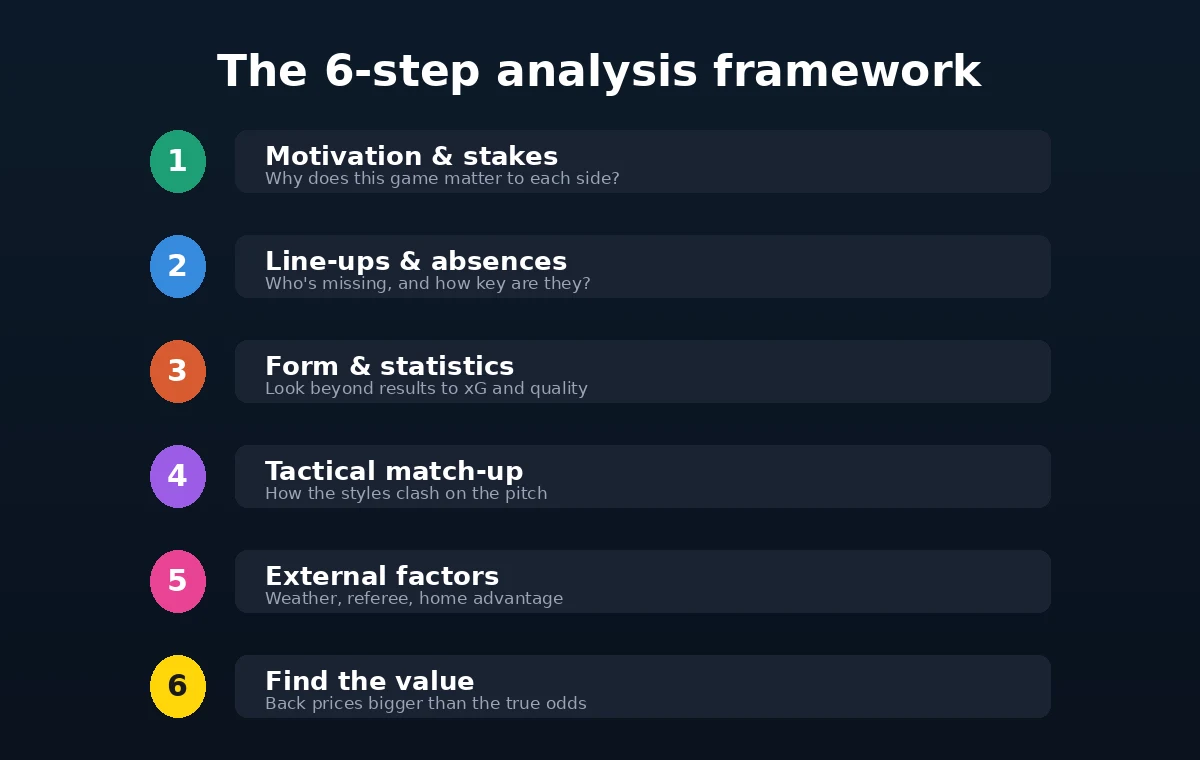
Step 1: Weigh up motivation and what's at stake
Before a single statistic matters, ask the simplest question of all: how badly does each team actually want this game? Numbers are meaningless if the players aren't fully switched on.
A side with a Champions League tie three days away might rest half their first eleven for a domestic cup. A team scrapping for survival is often far more dangerous than a comfortable mid-table outfit with nothing left to play for. Derbies and fierce rivalries can erase any gap in quality. And off-pitch turmoil — a manager on the brink, a dressing-room rift — frequently sparks shock results. Always understand why the points matter before you read anything into the form.
Step 2: Check the line-ups and absentees
Football is a team sport, but the loss of one pivotal player can unravel a team's entire pattern of play. Don't just scan the list of who's out — judge how important each absence really is.
If an attacking side is missing its creative hub in midfield, its goal threat can fall off a cliff. Look at bench depth too: can the replacement genuinely do the job, or is there a steep drop in quality? And in congested fixture runs, managers rotate heavily, so always wait for the confirmed team sheets — usually released about an hour before kick-off — before locking in a bet.
Step 3: Read the form and the statistics properly
The scoreline is a notorious liar. A team might have three straight 1–0 wins on paper, yet if you actually watched those games you'd have seen them cling on while opponents rattled the woodwork and were denied clear penalties. On paper: a winning streak. In reality: a side living on borrowed time.
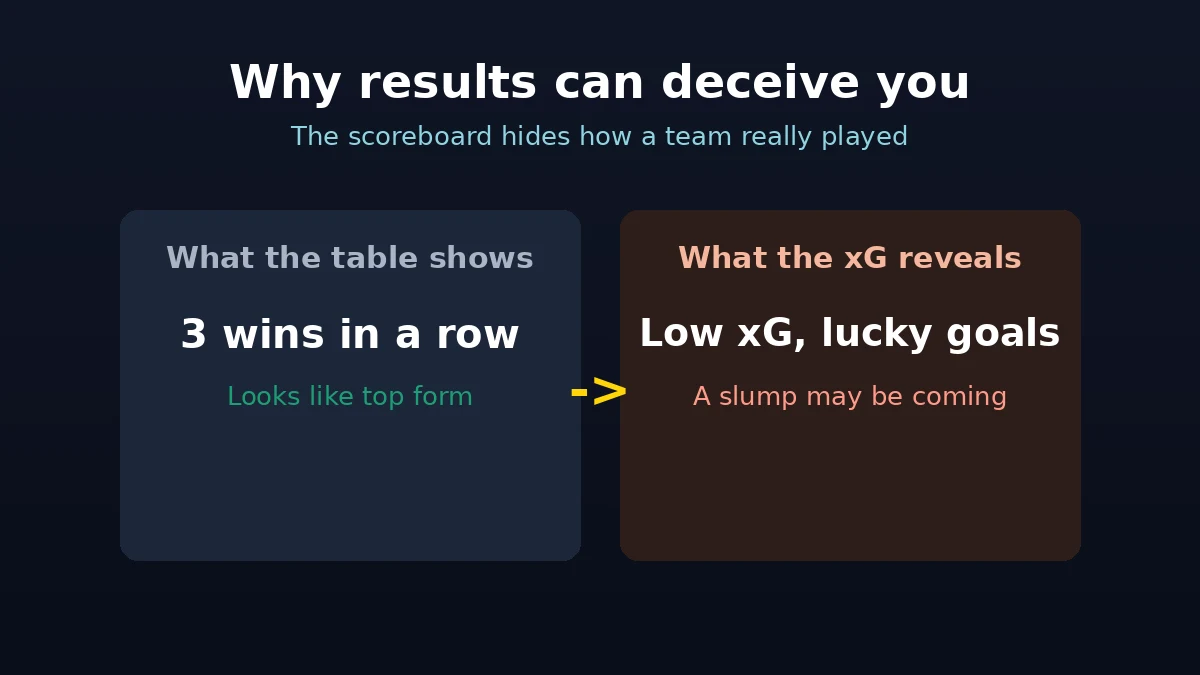
To avoid that trap, split your form analysis into three layers: recent results, the deeper metrics, and a head-to-head of the styles.
The last 5–10 matches
A window of five to ten games is the sweet spot — long enough to filter out flukes, recent enough to reflect a team's true current state. Look at the dynamics of any streak and, crucially, who it came against. Twelve points earned against the bottom of the table is worth far less than twelve points taken off the European places. Note how a team behaves under pressure too: do they fight back after going behind, and do they hold up in the final fifteen minutes? Late goals are a strong sign of character and a deep squad.
The advanced metrics
When the basic numbers run out, these are the figures club analysts lean on:
- xG (expected goals). Measures the quality of chances created. A high xG paired with few goals means the goals are "due" and tend to arrive soon — a useful pointer for an over bet next time out. Read our full xG guide for more.
- xGA (expected goals against). Reveals the true quality of a defence. A side conceding little purely thanks to a hot goalkeeper is riding their luck — once that keeper cools off, the floodgates open.
- Shots on target. Far more telling than raw shot counts. Twenty wild efforts mean nothing; it's the three or four that test the keeper that matter.
- Corners. A high count points to a team that attacks down the flanks and pins opponents back.
- Fouls and cards. Sometimes a tactical tool — cynical fouls in midfield to snuff out counters rather than a sign of a dirty side.
- PPDA (pressing intensity). Shows how aggressively a team presses. A low number means relentless, high pressing; a high number means they sit back in a low block.
Comparing the two teams
Stats only come alive when you set the two sides against each other and hunt for stylistic clashes. Pit the home team's attacking xG against the visitors' defensive xGA on the road — who's likely to dominate? Consider what happens when a fierce pressing side meets a team that buckles under pressure. Hunt for exploitable weaknesses, like visitors who leak goals from crosses facing hosts with a towering target man. The golden moment is when two trends cross in opposite directions — one team climbing, the other falling apart — because bookmakers are often slow to adjust their prices to catch up.
Step 4: Picture the tactical battle
Try to visualise how the ninety minutes will actually play out, because stylistic match-ups frequently decide the outcome. How will a fluid 4-3-3 break down a deep 5-4-1 "bus"? If both sides love to counter, the game may stagnate as neither wants the ball. And specific zone mismatches — a shaky left flank against a flying right winger — can swing the whole contest.
Step 5: Factor in the conditions
Sometimes the result hinges on things that have nothing to do with ability. Heavy rain or snow can drag a game down to a physical lottery and suppress goals. Referees vary enormously — some let everything go, others brandish cards at the slightest contact, which matters hugely for fouls and bookings markets. And home advantage is real: some clubs are transformed at their own ground and toothless away from it.
Step 6: Hunt for the value
All of this work has one purpose — not to "guess the winner", but to find value: a spot where the bookmaker has underrated the true likelihood of an outcome. If your analysis says a team has a genuine 50% chance (a fair price of 2.00) but the bookmaker is offering 2.30, that's a value bet. Over the long haul, consistently backing those mispriced odds is exactly what generates profit.
Common mistakes that quietly drain a bankroll
Even after wading through a mountain of stats, the human element can undo everything. These are the traps bettors fall into again and again.
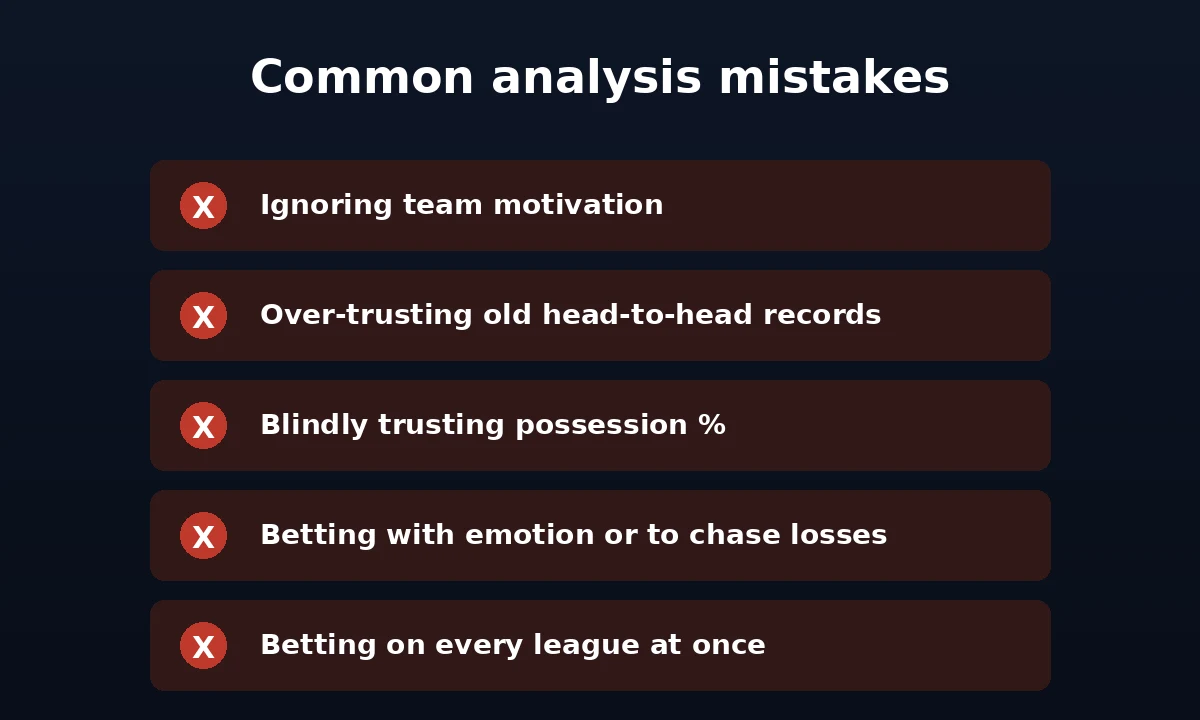
- Ignoring motivation. Reading only the league table — "second versus sixteenth, easy win" — without asking whether the favourite actually needs the points.
- Over-trusting head-to-head history. "They haven't won here since 2015" sounds compelling but is nearly useless; only the last two or three seasons, with similar squads, carry real weight.
- Worshipping possession. Seventy percent of the ball means nothing if it's sterile passing with no cutting edge. Always cross-check possession against xG and shots.
- Betting on emotion. Backing your own team, or chasing a painful loss with a bigger stake, swaps cold logic for wishful thinking.